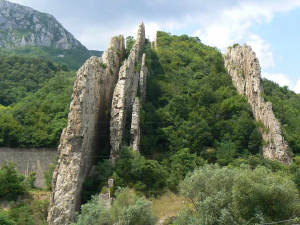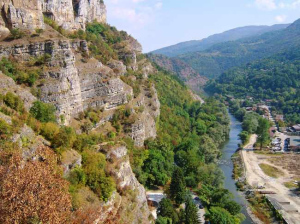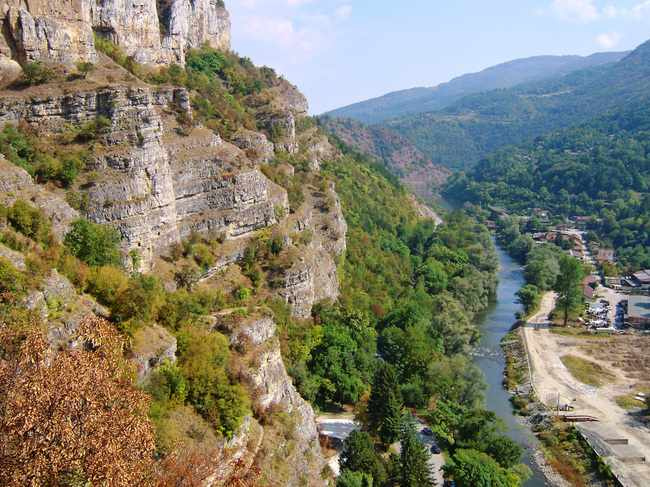
The Lakatnik Rocks were declared a natural landmark in 1966, and after 1989 they were declared a protected area. Also since 1989 the rocks have been included in the then created Vrachanski Balkan Nature Park.
The rock formations popular in recent times under the name "Lakatnik Rocks" are actually in the land of the village of Milanovo and are called Razhishkio Kamik (after the name of the nearest hamlet). The residents of Lakatnik called it Osikovskio Kamik, also known as the Osikovska Stena. (Osikovo is the old name of the village of Milanovo).
At the top of the rocks rises a massive monument, lined with local stone, built in memory of the fallen participants in the September Uprising in 1923. In 1950, the village of Osikovo (now Milanovo) was renamed after one of them (Milan Petrov). In fact, Milan Petrov did not participate in the September Uprising, but since his brother Simeon was the leader of the local insurgents, Milan was arrested and shot as a lesson.
Here, in the summer of 1931, an alpine rope was used for rock climbing for the first time in Bulgaria by Alexander Belkovski, Georgi Stoimenov and Nikola Chipev. They climbed the rocks to the right of the monument - the so-called "Palaces" and "Window" on a free rope. Since 1934, climbing and securing with wedges and carabiners began near the Lakatnik station.
By 1939, most of the most popular and now tours of the rocks above the Alpine Meadow had been carried out.
In the years after World War II, the rocks near the Lakatnik station became a favorite training place for climbers and cavers from Sofia and nearby settlements.
One of the most memorable views from the railway line is of the red house hanging high on the sheer cliffs. This is a small alpine shelter called “Eagle’s Nest”. The shelter was built in 1938 after a historic climb of the northeastern face of Malyovitsa by mountaineers from the Bulgarian Alpine Club Kotse Savadzhiev, Georgi Stoimenov, Georgi Tsenev and Todor Bozhkov-Tarzan.
The house was brought from Sofia disassembled and mounted on metal profiles fixed to the rock. In 2000, the shelter was renovated and expanded by 20cm so that taller people could also lie inside (before that it was only 180cm wide).