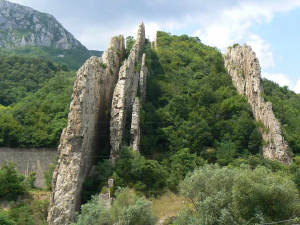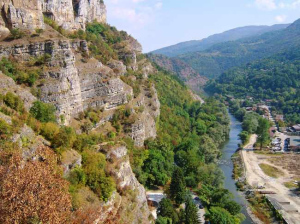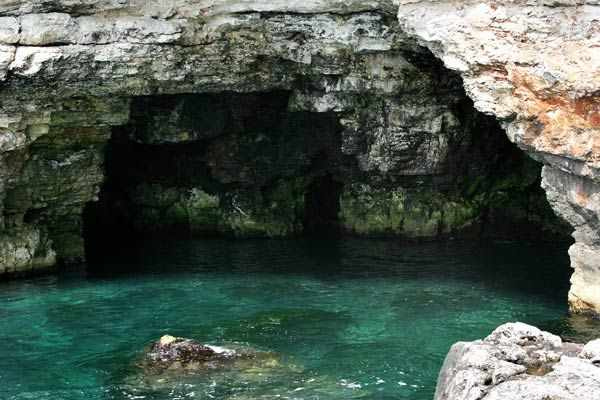
It is located northwest of the Lakatnik station, on the left bank of the Iskar River in the wall of a rock ridge.
Until recently, this was the longest cave in the Stara Planina Mountains.
It is a system of two main galleries with adjacent parts, developed on 4 levels. The gallery in the west-northwest direction is about 900m long without branches and floors. The northeastern part of the cave is longer - over 1000m along the axis, and the main underground river also flows along it.
The galleries are wide and high with a predominantly rectangular and inverted-trapezoidal transverse profile.
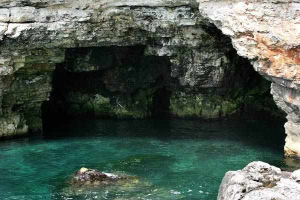
Usually the river drains underground through the karst spring Zhitolyub located under the cave. However, during extreme rainfall and snowmelt, the river raises its level and overflows through the entrance to the Temnata dupka, with the flowing water forming a waterfall.
In the past, there was an idea for the development of the Temnata Dupka Cave, but it was abandoned at an early stage. Now only the remains of the bars at the entrance remind of this. The cave is not a tourist site and tourists are not allowed to enter. Only speleologists are allowed to enter the interior for research purposes.
The cave was declared a natural landmark in 1963, and now falls within the boundaries of the Vrachanski Balkan Nature Park. The cave has the richest cave fauna in the country. 94 species of organisms have been discovered, 17 of which are troglobites. Perhaps the most famous is Protelsonia lakatnicensis (a species of higher crustaceans from the Stenasellidae family) - endemic to Bulgaria and to the cave (local endemic, i.e. it is not found anywhere else in the world except in this cave).
The taxon was first described by Ivan Buresh in 1962 and was named after the nearby village of Lakatnik. One of the largest crustaceans in the underground waters of Bulgaria, whose body length reaches 2 cm. The species is included in the Red Book of the Republic of Bulgaria as critically endangered.
In Temnata Dupka Cave, there are also 2 more species named after the village and 8 troglobytons named after Academician Buresh. The cave has been known to locals since ancient times, but the first documented visit to Temnata Dupka dates back to 1912, when Academician Iv. Buresh studied its bat fauna. The first map and description of about 150m of the cave were published in 1915 by Zheko Radev.
Research continued in the period 1921-1926. For this purpose, Eng. Pavel Petrov designed a special prefabricated double-hulled wooden boat to overcome the water sections. This boat was transported several times by train between Lakatnik and Devetashka Cave. The Temnata Dupka Cave was remapped in 1948, when the northwestern parts were discovered. Young speleologists under the leadership of P. Tranteev further explored the cave and in 1958 its length increased to 3200m.
Research in the Temnata Dupka Cave system continues today, with the total length of the galleries now exceeding 9km. The cave has blockages, an underground river, waterfalls and a series of lakes. The entrance parts have a labyrinthine character and are poor in secondary formations, but after the lakes in the new parts there are beautiful and still intact formations. At the end of the cave the river is lost in a siphon. In 2001, during a joint expedition, Belgian and French scuba divers entered 240m into the siphon and reached a depth of 20m.